Sunday, 27 April 2014

HMS Illustrious.

HMS ILLUSTRIOUS   20-Apr-42   to   22-Apr-42

HMS Illustrious had been delayed completion to allow the fitting of radar before her commissioning which finally occurred 24-Apr-40. Built in Barrow.
LOA    744ft
Beam   96ft
Draft   28ft
Speed  30.5kts
Displ    23100 tons
Crew   900 plus 350 aircrew
Amra   5 x 8 barrel 2lb pompom AA, 3 x 1 x 40mm Bofors AA, 19 x 2 x 20mm Oerlikon AA, 14 x 1 x 20mm Oerlikon AA, 36 aircraft.

HMS Illustrious had been severely damaged by aircraft in January 1941 whilst assisting Malta convoys and eventually ended up in Norfolk, USA after passing through Suez Canal and round the Cape of Good Hope. She finally left Norfolk 12-December 1941 in company with HMS Formidable. In atrocious weather Illustrious ran her bow into the stern of Formidable causing severe damage. Illustrious went to Greenock for repairs which were completed in March 1942. 23-Mar-42 she joined Convoy WS17 bound for Freetown.

HMS Illustrious.

It appears that there was some sort of a fire in the hanger deck and I think that on 31-Mar-42 she was detached from the convoy to head to Freetown for repairs. The rest of the convoy arrived on 6-Apr-42 and left again 11-Apr-42. I think the Illustrious must have still been under repair when the convoy left and later she made an independent passage to Durban. In the records of 829 Naval Air Squadron it records that the Illustrious called in at Cape Town. I assume that Dad boarded her on 20-Apr-42. The distance from Cape Town to Durban is roughly 1000 miles so Illustrious would only have needed about 25kts to arrive on 22-Apr-42 as is stated in Dads record, which is a lot less than her top speed of 30kts. Then Dad would have to wait for his next ship to arrive.

Monday, 21 April 2014

HMS Malaya.

HMS MALAYA   16-Aug-41    to    19-Apr-42

I wonder if Dad would have been disappointed with his first ship as Malaya wasn’t in the first flush of youth. She had been completed on 1st Feb- 1916 by Armstrong’s on the Tyne. She took part in the Battle of Jutland 31-May-16 where she fired 215 15” rounds and received 7 12” shell hits with 63 killed and 68 injured.
Length 645’
Beam   104’
Draft    30’
Speed   25kts
Displ.    31100 tons
Crew    1184 to 1300
Armaments; 8 x 15”, 12 x 6”, 4 x 4”AA, 2 x pom poms and 4 aircraft.

She was a Queen Elizabeth Class Battleship but was named Malaya as the Federated Malaya States paid the almost £3 Million costs. The other vessels were HMS Queen Elizabeth, Barham, Valiant and Warspite.

In March 1941 Malaya had been hit by a torpedo when near the Cape Verde Islands but suffered no causalities. She initially went to Port of Spain in Trinidad for temporary repairs and then went to Brooklyn in New York for full repairs. She was the first RN vessel to be repaired in the USA during WWII so assume Lend/Lease was in place at this time.

HMS Malaya in New York

Repairs in America were completed and she left USA 9-Jul-41 where she joined a convoy as escort from Halifax Nova Scotia to Rosyth where she arrived 28-Jul-41 with no losses. Malaya then re-entered the dock yard to have experimental anti aircraft and fire control radar and additional armaments fitted.

As she did not leave Rosyth until September Dad must have joined her there and started to get the ship ready after months in dock. From Rosyth they went to Scapa Flow where they were worked up to war readiness. She was nominated as part of Force H which was the naval task force in the western Mediterranean that was to replace the French navy after their surrender.

Official Recognition Card for HMS Malaya.
20-Oct-41        Malaya left Scapa Flow for the Clyde with destroyers Bedouin, Punjabi, Laforey and Lightning.
21-Oct-41        Arrived on the Clyde.
22-Oct-41        Left Clyde for Gibraltar with destroyer Lightning and later joined by Havelock, Harvester, Sikh and Zulu.
27-Oct-41        Arrived at Gibraltar but on entering the harbour she collided with MV Hoegh Hood (a Norwegian tanker that had suffered damage and was waiting for repair) and Clan Macdonald (sunk later that year) but only suffered slight damage to the bow.
November 41  Malaya became Flagship for Force H when Admiral Sir James Somerville raised his flag. It is said he hated the ship and thought it most unsuitable.
10-Nov-41       Left Gibraltar with cruiser Hermione to cover Operation Perpetual, (the delivery of Hurricanes to Malta from the carriers Ark Royal and Argus). A screen was provided by the destroyers Laforey, Lightning, Sikh, Zulu, Gurkha and Dutch Navy vessel Isaac Sweers.
12-Nov-41       37 Hurricanes flown off and force turn west to return to Gibraltar.
13-Nov-41       At 1541 30’ from Gibraltar the Ark Royal was torpedoed by U18. The spread of 4 torpedoes had been fired at Malaya! Malaya dashed off to the safety of Gibraltar but as the Ark Royal didn’t sink she was turned round at 1622 to cover the rescue mission. At 1830 she was again ordered to return to Gibraltar. Ark Royal sank the next day, 14-Nov-41, whilst under tow of the navy tug HMS Thames.
16-Nov-41       Dad was promoted to the rank of Coder!

HMS Legion taking crew off HMS Ark Royal
December 41   Malaya stayed in Gibraltar to provide cover for Atlantic trade convoys as she was the only battleship in the western Mediterranean at the time.
14-Jan-42        Rear Admiral Edward Neville Syfret raised his flag in Malaya. It seems that Dad would be associated with this Admirals staff for a while as he moved from ship to ship with him. He had been born near Cape Town South Africa and had been Dartmouth Chief Cadet Captain. He played cricket once for the Navy scoring a duck and 30 runs. He appears to have had a reputation as being grumpy.
E.N.Syfret
8-Feb-42          Left Gibraltar for the Clyde, with cruiser Hermione and destroyers Active, Anthony, Blankney, Croome, Exmoor, Laforey and Lightning. Force H was being sent to the UK to cover the possible breakout of the Scharnhorst and Gneisenau from Brest.
13-Feb-42        Arrived on the Clyde.
17-Feb-42        Force H sailed from the Clyde in company with carriers Eagle and Formidable (with Admiral Sir James Somerville aboard), cruiser Hermione, destroyers Duncan Laforey and Lightning to join the important Convoy WS16 which had 45000 troops aboard. There were 14 merchant ships and after more destroyers joined (Active, Anthony, Blankney, Croome, Firedrake, Panther, Verity, Walker and Witherington) a huge escort.
21-Feb-42        MV Strathdeen caught up with the convoy having been delayed. She had an escort of cruisers Newcastle and Paladin.
23-Feb-42.       Malaya and Force H arrived back in Gibraltar having detached from Convoy WS16 whose ultimate destination was Bombay.
Dad on Liberty from Malaya in Gibraltar 1942.
27-Feb-42        Left with Force H and carrier Eagle and her 5 destroyer escort to sail east towards Malta for ‘Operation Spotter’, (Delivery of Spitfires to Malta). They were later joined by carrier Argus, crusier Hermione and their escort of four destroyers.
28-Feb-42        The operation was cancelled as there was some difficulty with the aircrafts long range fuel tanks. All vessels returned to Gibraltar.
6-Mar-42         A repeat of Operation Spotter and fifteen aircraft arrived in Malta.
21-Mar-42       Malaya and Force H covered ‘Operation Picket 1’. This was again a plan to get aircraft to Malta and was a partial success as nine Spitfires made Malta, but again problems were found with the long range fuel tanks.
27-Mar-42       ‘Operation Picket II’ and a further seven aircraft made Malta.

HMS Malaya from an escorting destroyer.

30-Mar-42       Malaya returns to Gibraltar and learns that they are nominated to take part in ‘Operation Ironclad’, the invasion of Madagascar.
1-Apr-42         Sailed from Gibraltar with cruiser Hermione and destroyers Active, Anthony, Laforey, Lightning and Duncan.
6-Apr-42         Arrived in Freetown.
9-Apr-42         Left Freetown as ocean escort for Convoy WS17 with additional destroyers Inconstant, Javelin, Lookout and Packenham. The convoy consisted of 32 merchant vessels 19 of which carried troops. Franconia had the Commodore aboard and the ultimate destinations for some of the vessels were Suez/Aden and Bombay.
18-Apr-42       Malaya was detached from the convoy and put it to Cape Town. Once alongside she was ordered to return to Freetown and then back to Gibraltar.
19-Apr-42       Dad signed off the Malaya and was posted to HMS Ramillies but she had just left Kilindini, Mombasa for Durban. Dad had to hitch a ride to get there.

Sunday, 13 April 2014

HMS Victory 3.

HMS VICTORY 3   24-Jul-1941    to    16-Aug-41


Woolley Park House. Daily Mail


Woolley Park is a 17th Century House that is owned by the Wroughton Family and has been since it was built. It must have been commandeered during the war. Again I’m not sure if Dad would have actually gone here or just the paperwork carried out, but I assume that it would have been a safe barracks for ratings waiting for postings, even if it was a temporary camp in the extensive grounds. In any case he was only there just over three weeks before posting to his first real ship.

Saturday, 5 April 2014

HMS Cabbala

HMS CABBALA   5-Apr-41    to 24-Jul-41

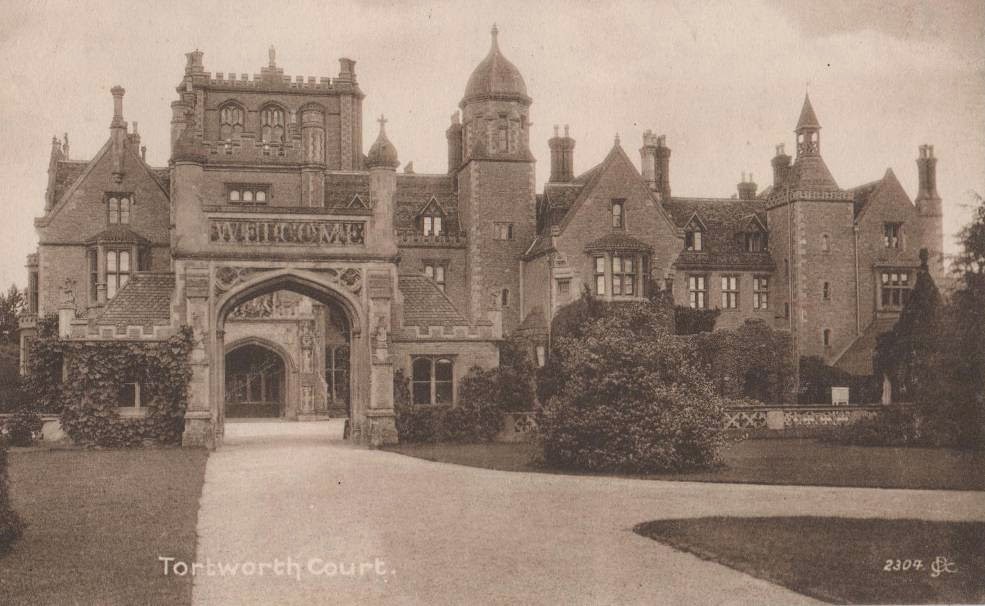
HMS Cabbala was another ‘stone frigate’ and during Dad’s time was situated at Tortworth Court, Wotton under Edge, midway between Gloucester and Bath.

Tortworth Court before the War.

Tortworth Court had been the estate of the Ducie Family since 1620. The family seat was originally at Woodchester high in the Cotswolds. As the 2nd Earl suffered from rheumatism and arthritis he decided to build a new, more commodious house, at a lower elevation and less prone to fog and wind. Samuel Sanders Teulon was chosen as the architect and the house was completed between 1849 and 1853. It was equipped with all mod cons of the age, including gas lighting with its own gas works and hot air central heating the furnaces of which were supplied with coal by its own railway. The 3rd Earl further developed the property and added a still important arboretum in the grounds. The 3rd Earl died in 1921 and as his son had predeceased him the title passed to his brother who was farming in Australia. The 4th Earl died in 1924 and his son inherited. He was also farming in Australia but divided his time between there and Tortworth Court.
At the outbreak of the War the family was in Australia. He offered the house for use by the Australian Navy but the British Navy took it over as HMS Cabbala in 1941 for use as a code and signal school. As all shore establishments are considered to be ‘ships’ by the navy the morning and evening flag ceremony had to take place but as HMS Cabbala was semi secret the flag was erected in the central hall away from prying eyes. In 1942 HMS Cabbala was relocated to Warrington and the house taken over by American servicemen. A hospital was built in the grounds and there the American wounded from the North African campaigns and the D Day landings and advance into Germany were treated.

After the War the 6th Earl died and his son took over the running of the estate. It is still in the family and is very well and efficiently run. Tortworth Court was sold for conversion into luxury flats and houses but a fire in 1991 caused everything to stop. The building was left derelict until 1999 when it was bought and sensitively restored to a luxury hotel by Four Pillars Company.

Dad was there for about three and a half months for the training as a Coder. I haven’t got much information about what was involved but obviously they received signals and had to either decode or encode them for transmission or reading.


Prior to a posting to a vessel Dad was again listed as being attached to another accountancy ‘stone frigate’.

Saturday, 29 March 2014

HMS Victory 1

HMS VICTORY 1   10-Feb-41    to    5-Apr-41

All ratings are assigned to a division, Chatham, Portsmouth etc. and Dad was sent to the Portsmouth Division. This is also indicated by the JX of his serial number1. His date of enlisting is given as 10th February 1941 and he was sent to HMS Victory 1 as an Ordinary Coder.  It seems that HMS Victory 1 was a ‘stone frigate’ and was not the HMS Victory of Nelson fame but an accounting place for ratings that had not been assigned to formal duties. I assume that Dad would have had to go to Portsmouth Barracks at some stage and on 10th March 1941 there was a very bad raid on Portsmouth and an 8ft hole was actually blown in the side of Nelson’s HMS Victory. (update; pay for an Ordinary Coder was 2 shillings a day. That compares well with a wage of 10/- or 15/- at Hollis’s).

Portsmouth Main Dockyard Gate 1901.

Between 1940 and 1944 HMS Victory 1 seems to have been based at Goodings Nr Newbury. I can find little about this place. It seems to have been a Franciscan Monastery before the war and was the oldest in England for the Third order of Franciscans. It seems as though it held an archive of papers for the order.
After the war in 1947 the place was taken over by New Hall Preparatory School, a catholic girl’s school, in 1947 with 14 girls and had to move in 1953 when it had 100 pupils.


Training at Whale Island, Portsmouth. (Dad middle row, 2nd right)

The photo above is titled ‘Training at Whale Island, Portsmouth’ so indicates that at least part of the basic training was carried out in Portsmouth. The dates fit with Dad’s eight weeks basic training taking place here. His next posting was for training as a Coder.

A Little older and wiser April 1943.

Wednesday, 26 March 2014

Build up to war.

WILLIAM KEITH PORTER
21 June 1922
22 May 2004

TIME AS A RATING IN THE NAVY
PJX 252239

Dad at Scarborough 1938

In the above photograph Dad was 16 and had probably just left Hymers College in Hull where he had been at school. He didn’t pass his school certificate as he only got 2% in French and you had to pass all subjects to obtain the certificate. He started work at Hollis Bros. and Co Ltd as Office Boy. Hollis’s were a very big company that imported timber and manufactured products from it. They started in 1888 in Leicester and opened a branch in Hull in 1903. They built a factory in Craven Street, off Holderness Road in 1911. This was extended in 1920 and eventually expanded between Holderness Road and Hedon Road with timber yards by the river by the time Dad worked there. It was all knocked down in the mid 1980’s and now has a shopping complex and housing estate on most of the land. Dad started at Hollis’s on 26th September 1938 at a salary of 10/- a week, rising to 15/- after an eight week trial period. It seems that he had a bonus cheque waiting for him after D-Day so he must have done something right.

Mum told me that Dad first volunteered for the Fleet Air Arm around his 18th birthday, but following a medical was rejected due to his colour blindness. I assume that he must have been hoping for flying crew for this to matter. He eventually volunteered, and was accepted, for the Royal Navy Volunteer Reserve. This indicates that he definitely volunteered and was not called up, otherwise he would have been enlisted into the Royal Navy.


Craven Street Head Office of Hollis Bros.

Dad did have some contact with the sea as his Uncle on his Mother’s side was Stan Chesterfield who had served his time on the 3 masted barque Killoran which was the last such vessel under the Red Ensign. An Uncle on His his Father’s side, Frank Porter, who had lost and arm and a leg in the Great War, worked for a tug company in Hull and other relations were the Fosters who owned a tug company on the Humber. I remember Dad telling me that he had been aboard a paddle tug in the Old Harbour at Hull called the King Tut. I see that Peter Foster Co. Ltd had four tugs in 1935 one was the Ace Tut built in 1886 and another was the King Tut built in 1919, 39 GRT and made of wood.

I’m not sure when or how it was organised but there are photographs that show that dad could have gone away to see on two trips. One is definite as he is in one of the photographs. The photographs are a little mixed up but I would say that it could have been the summer of 1938, after he left school and before he started work at Hollis’s.

I’m not sure which one he would go on first but the oldest of the two was SS Phaeacian. She was a steam coaster built as the first ship of F.W. Horcock, Ocean Transport Co. in Mistley, Essex in 1920. She was 480 GRT. She was actually sunk in a collision 2 miles south of Kincraig Point, Near Elie, Scotland 29-Sep-1943.

Dad on the focstle of SS Phaeacian

Captain Stewart and his wife SS Phaeacian

From the photographs Dads trip seemed to take in Southampton, Ipswich and the Firth of Forth. The collision took place between the Phaeacian and the Eagle Tanker Co Ltd vessel San Zotico. She was 5582 GRT and had been built at Swan Hunters as the SS War Kookri but had been bought by Eagle Tankers on the stocks and named San Zotico. The Phaeacian survived the collision and was taken under tow but sank shortly afterwards. She is currently at a depth of 6 fathoms and in three parts.

The other ship that it seems certain Dad actually sailed on for a trip was MV Ngatira. She was built in 1931 at Alblasserdam to the east of Rotterdam on the Maas. She was 528 GRT and 165’ long 26’ wide and 12’ deep. Her 513 BHP motor engine drove her at 9.5kts. She was owned by the National Gas &O.E. Co. Ltd of Ashton under Lyne. Dads voyage took him to Portsmouth, Guernsey, Alderney, London, Middlesborough and Hull. 

SS Phaeacian in Ipswich Dock (Best I can do with a very dark photo!)

MV Ngatira alongside in Guernsey.

MV Ngatira making way in a choppy English Channel.


Captain of the MV Ngatira.
In 1946 the ship was sold and the name changed to ‘Springwood’. The vessel was again sold in 1947 and the name became ‘Cabourne’. She was again sold on in 1968 and this time the name was ‘Delfino’ and she was working in Ethiopia. She was finally deleted from shipping registers in 1996!

MV Cabourne

MV Cabourne


As ‘Delfino’ in 1978 in Ethiopia.

SS Killoran Built 1900 at Ailsa Shipbuilding, Troon. Sold to J. Hardie and Co in 1909. Bought by Gustaf Erikson of Mariehamn Finland in 1924. She loaded corn and sugar at Buenos Aires and sailed on 15th June 1940 for Las Palmas. She was controversially sunk on 10th August 1940 by a German Armed Merchant Cruiser ‘Widder’. She was a neutral ship taking cargo to a neutral port. Stan Chesterfield served his apprenticeship on this vessel.

SS Killoran off Durban from Clan Fraser 17th Sep 1939

Please forgive my indulgence with the photographs of the ships etc. as they are only marginally relevant to Dads military biography but I hope that you find them interesting. My Father's Uncle Stan served his apprenticeship on this vessel and later became the master of the Pilot Cutter on the Humber and did sterling work throughout WW2. I was told by somebody who worked with him over this period that he almost never went off duty and kept the the flow of ships in and out of the river going. He  died fairly young and maybe the hard work at this period shortened his life.


Sunday, 23 February 2014

My Dad's War.

WILLIAM KEITH PORTER


Over the course of a couple of years I researched my Father's time in the Royal Navy Volunteer Reserves. It has become quite a normal thing to research into your relations and create family trees down the ages. Unfortunately my Father died in May 2004 before I showed any great interest in these matters. He had been an only child and his parents had collected a certain amount of items and information. These were of the first point of contact to me. As my Mother is still alive we  were able to request my Father's records form the Navy and this put a little more meat on the bones. My parents were not married when he was at war, and although they knew each other they weren't even going out until right near the very end of the period covered so Mum has been able to flesh out only a little more detail.

It seems that in common with many of those who served their country at this time they did not talk much of their experiences to anybody. It  has been quite a personal journey with many side tracks as I have been caught up in information that I found interesting but nothing to do with my Dad's story. It ended up becoming a much longer history than I expected as it was just so my brothers and I could have some permanent record of his exploits to keep and pass on in the future. It is Dad's personal story. There are no great revelations but  wasn't sure about allowing others to read it.

What changed my mind was the vast amount of information that people have made available on the internet, through many sources, and were therefore available to me. There were several times when I was stuck in my tracing of his time, only to regain the scent via somebody having put their personal history to be available for others. I hope therefore by making this available to others not only will I set my Fathers place in history but hopefully add to the resources for others to utilise the internet for future use.