Sunday, 18 May 2014

HMS Nelson.


HMS NELSON   11-Jul-42   to 26-Aug-42

HMS Nelson had been built on the Tyne and commissioned in August 1927. He sister ship Rodney was commissioned in December the same year. These ships were very distinctive as they were the only vessels to carry 16” main armaments and all the main guns were carried in turrets forward. This came about due to the limitations imposed by the Washington Naval Treaty of 1922 that limited battleships to a tonnage of 35000t. To fit 16” guns compromises had to be made. The size of the engine and boiler rooms were reduced to lower the tonnage and so top speed was only 23.5kts. This then meant that the guns could all go forward and the accommodation aft to balance them. The main amour plating was also limited to vital areas.

LOA    710’
Beam   106’
Draft   31.5’
23.5kts
Displ    33900 tons
Crew   1330 to 1558
Arma   9 x 16” in 3 turrets, 12 x 6” in doubles, 6 x 4.7” x 2 AA, 48 x 2lb AA, 16 x 40mm AA, 61 x 20mm AA, 1 x aircraft and catapult.

HMS Nelson seen in 1939.

In September 1941 Nelson had been escorting convoys to Malta when she was hit by an aerial torpedo from an Italian plane. Although damaged she eventually got back to Rosyth for repairs. When they were completed in May 1942 she assisted in the escort of convoy WS19P as far as the coast of Angola where she was turned back to Freetown, arriving on 1st July. As Dad joined Nelson on 11th July I assume that he joined as soon as the Canton arrived in port.


Dad on the left and unidentified shipmate aboard HMS Nelson.


17-Jul-42         Nelson sailed form Freetown in company with Rodney and destroyers Derwent, Pathfinder, Penn and Quintin.
26-Jul-42         Arrived in Scapa Flow and was nominated to join Force H in the Western Mediterranean.
27-Jul-42         Promoted Admiral Syfret hoists his flag and starts preparations for ‘Operation Pedestal’ to re-supply Malta. In the following week meetings were held and plans made. Maximum AA ammo was loaded.
2-Aug-42         At 1600 Nelson sailed from Scapa Flow with Rodney and a destroyer escort of Eskimo, Pathfinder, Quentin, Tartar and Somali.
3-Aug-42         The Nelson’s group joined up with convoy WS21S off Ireland. This was the name of Operation Pedestal ships to confuse the enemy.
9-Aug-42         At 2300 entered the Strait of Gibraltar. Nelson and Rodney, carriers Eagle, Indomitable and Victorious, cruisers Phoebe, Charybdis and Sirius were designated as Force Z. These capital ships could not be endangered in the narrow and shallow seas of the Skerki Bank (called Bomb Alley by the seamen) and so would have to turn back before reaching Malta.
10-Aug-42       Aircraft were flown off to make dummy attacks to test the fire control and air defence radars. Time was also made to practise manoeuvring in convoy. It was felt that the moonless night may mean that the fleet had not been detected.
11-Aug-42       Two fleet oilers were busy refuelling the fleet of warships from 0630 to 2000 as all ships had to have enough fuel to return from Malta rather than deplete the islands stocks. Early in the morning Eagle was hit by four torpedoes fired by U73 but although she sank many were saved but 160 out of a crew of 927 perished. The carrier Furious however managed to fly off 37 Spitfires that flew to Malta as reinforcements (Operation Bellows). When Furious was heading west again one of her escort, Wolverine detected and rammed an Italian submarine which was lost. Up to 1900 four heavy air attacks were flown against the convoy but damage was limited. A merchant vessel had her speed reduced by a near miss, a destroyer was damaged by a torpedo (later scuttled) and the carrier Indomitable had her flight deck put out of action although she could still make 28kts. Slight damage was also caused to the flight deck of Victorious.


12-Aug-42       Another Italian submarine was rammed by one of the escort destroyers and was badly damaged herself in the encounter. In the morning an air attack was met by the carrier fighters and the heavy ships AA fire also proved a deterrent. At noon further air attacks were started. They were not coordinated very well so there were breaks between however Indomitable’s flight deck was finally put out of action for good. Force Z with Dad aboard Nelson had now reached the Skerki Bank between Sicily and Cap Bon, Tunisia and had to turn round and head back to Gibraltar. Meanwhile the rest of the convoy, Force X, started to form two columns instead of four. Just at this time HMS Nigeria and Cairo and tanker Ohio were hit by torpedoes from an Italian submarine. The two navy ships were to be the two column leaders and with the loss of destroyers to cover the damaged vessels confusion and scattering of the convoy occurred. On hearing of the losses Admiral Syfret ordered Charybdis, Eskimo and Somali to return to reinforce Force X. The confusion in the convoy cost heavily and with a severe air attack between 2035 and 2100 and then attacks from Italian submarines 2 merchant men were sunk and one damaged and a destroyer also sunk.

As Operation Pedestal was so crucial to the war effort I will quickly summarise the next few days of the convoy even though Dad’s ship had now turned back to Gibraltar. A little after midnight on the 13th August 15 enemy MTB’s attacked and with the reduced escort and merchant ships strung out they found easy targets and three cargo vessels were sunk. HMS Manchester was also damaged and later scuttled. During daylight 12 German bombers attacked and another merchant ship was sunk burning debris form which set fire to another vessel and some of the crew abandoned prematurely. She eventually made it to Malta. Later an attack by 60 Stuka dive bombers concentrated on the already damaged Ohio. At this time she was the largest tanker in the world and owned by America but had been loaned to Britain and was manned by a British crew. Near misses buckled her hull plates and No.1 hold had to be flooded. A stricken German plane actually crashed on to the deck of the Ohio and another crashed into the sea but skipped along and again crashed into the ship. But it was a brace of near misses that straddled the vessel


and ruptured her boilers that finally stopped her in the water at 1050. Further air attacks caused more damage but at 1800 Rochester Castle, Port Chalmers and Melbourne Star entered the Grand Harbour in Malta. More air attacks were again aiming to sink the disabled Ohio. HMS Penn was attempting to tow her but the heavy dead ship kept parting the rope. Yet another attack came and when another bomb landed in the same place that the torpedo had struck and the vessels back was broken. The crew finally abandoned ship just as another attack started.

Damage to the bow of Brisbane Star in Valletta Harbour

On the 14th August the badly damaged Brisbane Star limped into Malta. Great efforts were been made to get Ohio into port with her vital cargo. They eventually managed to start making progress by tying HMS Penn and Ledbury to either side to prevent her sinking and using a mine sweeper aft as a rudder as another bomb had holed her stern and damaged the rudder. The whole group finally made port at 0930 on the 15th to be greeted by masses of cheering people on the heads. Her cargo was pumped in to two other tankers and immediately she settled on the bottom of the harbour.

SS Ohio supported by HMS Penn and Ledbury arriving in Malta.


The convoy was said to be a great strategic victory as it was vital that Malta was kept supplied and fighting as it was a base to harass the supply lines to the German Africa Corp. If the Germans had been able to build up supplies it would have been impossible to prevent them taking Egypt and then close the Suez Canal and gain access to the huge oil supplies of the Middle East. This at best would have prolonged the European War or ultimately meant that the Allies would have lost. 400 lives were lost and thirteen ships sunk to get 32000 tonnes of stores plus various fuels to the island as only 5 of the original 14 cargo ships arrived. The supplies were enough for a further 10 weeks above the two or three weeks that already were held. Perhaps the best result of the operation was to stiffen the resolve of the forces and population of the island to continue enduring the constant air raids and deprivations, and ultimately the Island was awarded the George Cross for their efforts.
Vessels taking part were,
2 battleships                                       
4 aircraft carriers (thought to be the only time 4 carriers were involved in the same operation)
7 cruisers
16 destroyers
14 merchant ships

Lost and damaged
1 carrier sunk, 1 damaged
2 cruisers sunk, 2 damaged
1 destroyer sunk, 2 damaged
9 sunk, most damaged to some extent

2 enemy submarines were sunk and 1 damaged and 42 out of an estimated 330 planes were shot down.

HMS Nelson leaving harbour under tow before the War.

15-Aug-42       Force Z, including Dad on HMS Nelson, arrives back in Gibraltar.
20-Aug-42       Nelson sails from Gibraltar carrying survivors from Carrier Eagle and Cruiser Manchester and accompanied by escort carriers Argus and Furious and cruiser Kenya.
25-Aug-42       Vessels arrive back in Greenock. The ship then moves round to Rosyth on the Firth of Forth for a refit.
26-Aug-42       Dad is to change ships once again, but not too much of a change!

Dad on the right and Jock (John H. Hogg!) I think it looks like Malta. Mum says that they kept in touch with Jock for several years after the war until he died.

Sunday, 11 May 2014

HMS Canton.

HMS CANTON   22-Jun-42   to   10-Jul-42

The only Canton I can find was an armed merchant cruiser. I can find no proof that she was near Durban at this time. However in an album kept by P.R. Porter (Dad’s Dad) it says that Dad made the1800 mile rail journey from Durban to Cape Town along with the rest of the Admirals staff. This would explain the two days between leaving the Ramillies and joining the Canton.

SS.Canton recently completed new.

HMS Canton was originally P&O’s Canton. She was built in Glasgow and launched in 1938 for use on the London, Bombay, Singapore, Hong Kong, Yokohama run.
LOA    566’
Beam   73’
Draft   30’
Speed  18kts
GRT    15748 tons
She briefly went aground in the Thames on her maiden voyage and then collided with French liner ‘Marechal Joffres’ in fog off Hong Kong. She was three weeks being repaired. Later she rescued 39 passengers from the Danish Liner ‘Asia’ which was on fire.

HMS Canton as a troopship after conversion in April 1944.

The Royal Navy took her up from trade in October 1939 and converted her to an armed merchant cruiser in Glasgow were 8 x 6” and 2 x 3” guns were added. On leaving the Clyde she ran aground off the isle of Lewis in a gale. Two holds were flooded and she was abandoned. A few days later, on 11-Jan-40, she came free herself and was boarded and taken back into Glasgow. She was once again fully seaworthy in April 1940 and was put to work as convoy escort in the South Atlantic working often along the coast of Africa. She was refitted and upgraded on the Clyde again in July 1942 which would indicate that she was making her way north when Dad joined her. She was converted to a troopship in 1944 and handed back to P&O in 1947.

I must assume that Dad joined Canton in Cape Town on her way north and left her on arrival in Freetown to join his next ship that was already there.

Monday, 5 May 2014

HMS Ramillies.

HMS RAMILLIES   23-Apr-42   to 19-Jun-42

Ramillies was a Royal Sovereign class Battleship and was named after the Battle of Ramillies in the Spanish Netherlands, which today equates roughly to modern Belgium. The Duke of Marlborough won this battle in 1706. HMS Ramillies was completed in Glasgow in 1917, just too late to take part at the Battle of Jutland. Once again Dad had joined a vessel that wasn’t exactly straight from the builders yard.
LOA    624’
Beam   88’
Draft   28.5’
Speed  21.5kts
Displ    29150 tons
Crew   1124
Arma   8 x 15”, 12 x 6”, 8 x 4” AA, 16 x 2lb AA, 1 aircraft (The right hand barrel, as you look from the front, of the gun outside the Imperial War Museum is from HMS Ramillies).

HMS Ramillies in 1943.

Ramillies had been operating out of Ceylon (now Sri Lanka) and Addu Atol ( A British Naval base on the southern most Maldives Island, constructed in 1941 and later became RAF Gan). Her task had been to prevent the Japanese entering the Indian Ocean but with the fall of Malaya etc they were to secure Madagascar to prevent the Japanese taking it and therefore being able to threaten our supply lines to Egypt and Burma/India. They were nominated for Operation Ironclad (Invasion of Madagascar) as a replacement for Malaya who had been required back in the Mediterranean to assist in the protection of Malta convoys. She sailed from Kilindini, the port of Mombasa, on 16th April.

22-Apr-42       Ramillies arrives in Durban and Rear Admiral Syfret raises his flag in her.
23-Apr-42       Dad joins Ramillies after arriving in Durban aboard the Illustrious.
28-Apr-42       Sailed from Durban with carrier Illustrious, cruiser Hermione and destroyers Laforey, Lightning, Lookout and three others.
3-May-42        All the ships taking part in Operation Ironclad join up and organise for the invasion. Carrier Indomitable with destroyers HMAS Nizam and Norman join fleet.
5-May-42        Troop landings were started on the west coast in Courrier Bay, opposite Diego Suarez Bay. Ramillies gave covering fire. The landings were unopposed as the Vichy French had thought it impossible to get an invasion fleet through the reefs.
6-May-42        The advance towards the towns of Antsirane and Diego Suarez was been helded up by resistance from the Vichy French. It was decided to transfer 50 of the marines from Ramillies direct to Diego Suarez Bay using HMS Anthony. The troops were aboard her at 1545 and she set off at full speed round the north of the island with the Ramillies following at a slower pace. In the dark Anthony raced through the 500 yard channel protected by 12.5” guns. Fire was received but was not accurate and was returned in full measure. Anthony dropped the Marines alongside the port at 2000 and they achieved surprise and took all their objectives very quickly and broke resistance of the enemy troops.

Operation Ironclad.

7-May-42        At 1040 Ramillies opened fire with her heavy armaments on shore targets and ceased fire at 1050. By 1500 the enemy in the area had surrendered.
8-May-42        Ramillies entered Diego Suarez Bay and anchored.
29-May-42      During the evening a float plane was spotted at high altitude and a few rounds were fired at it. There is also a story that a float plane was seen to make to land in the bay that night. As it was between Ramillies and Frobisher and there was some doubt as to identification no guns were fired at it and it moved away. Whether it was the same plane or not it was later learned that it was from the Japanese submarine I-10 and with it’s information an attack was planned by mini submarines from mother submarines I-10, I-16 and I-20.
30-May-42      The Navy assumed that the plane was from a Japanese warship. Frobisher and Ramillies
made steam and Frobisher left Diego Suarez Bay for the safety of the sea but before Ramillies could
depart the results of an aerial search to 200’ out reported all clear and Ramillies re-anchored near to the tanker British Loyalty.
HMS Ramillies following a refit in 1939

Around 1730 I-16 and I-20 launched their mini subs (M-16 and M-20). I-10 didn’t make the rendezvous as she was damaged in bad weather. M-20 penetrated the harbour and at 2025 fired a torpedo at Ramillies. It hit on the port side below ‘A’ turret making a 30’ x 30’ hole in the bulge and bottom plating. Just as the torpedo struck Dad was having a mug of cocoa.

The explosion caused the vessel to leap in the air. The rim of the cocoa mug hit him on his front tooth and that is how he got the chip that was with him for the rest of his life. There was an initial loss of electrical power and the 6” armour plating was bent upwards. The forward magazine and shell rooms for the 15” and 6” guns were flooded. Dad said that all the hammocks and blankets etc were taken to try and plug the hole.
At 2120 M-20 fired her second and last torpedo. After the first explosion British Loyalty got underway and as she was moving astern the torpedo hit her, saving the Ramillies. M-16 never attacked and was never found, but a body was found later. After her attack M-20 left the bay and headed north to the rendezvous. When her batteries ran out she was beached. The demolition charges didn’t go off. The two crew made contact with local natives and were escorted towards Cape Amber, the northern most point. On 1st June they enter a village and ask for food but are later denounced to the British. On 2nd June Marines from 5 Commando intercept them and a fire fight ensues where the two Japanese are killed along with one Marine. There is a monument to the Japanese at the spot.

Similar Japanese midget submarine showing scale.

31-May-42      Ramillies was moved to a small bay with her bows pointing seaward to present the smallest aspect. The forward draft had increased by nearly 20’. To counteract this the Union Castle vessel Greystoke Castle was brought alongside and the anchors and cables, ammunition and stores from for’d were transferred to her and other measures taken to stem the flow.
2-Jun-42          The Constructor Officer for the Eastern Fleet arrives on the destroyer Decoy and confirms that Ramillies is seaworthy enough to move to Durban.
3-Jun-42          She leaves for Durban escorted by cruiser Emerald and destroyers Active, Decoy and Duncan.
7-Jun-42          The escort was strengthened by corvettes Fritillary and Jasmine.
9-Jun-42          Arrive in Durban and repairs immediately commenced. Ramillies finally sailed for Cape Town on 6th August for further repairs. Her main armament was inoperable for this transit. She left Cape Town on 13th August for Devonport via Freetown and Gibraltar. She finally arrived 8th September and repairs were not completed until June 1943!
16-Jun-42        Dad signs off the Ramillies and his records show he was posted to HMS Canton.

Sunday, 27 April 2014

HMS Illustrious.

HMS ILLUSTRIOUS   20-Apr-42   to   22-Apr-42

HMS Illustrious had been delayed completion to allow the fitting of radar before her commissioning which finally occurred 24-Apr-40. Built in Barrow.
LOA    744ft
Beam   96ft
Draft   28ft
Speed  30.5kts
Displ    23100 tons
Crew   900 plus 350 aircrew
Amra   5 x 8 barrel 2lb pompom AA, 3 x 1 x 40mm Bofors AA, 19 x 2 x 20mm Oerlikon AA, 14 x 1 x 20mm Oerlikon AA, 36 aircraft.

HMS Illustrious had been severely damaged by aircraft in January 1941 whilst assisting Malta convoys and eventually ended up in Norfolk, USA after passing through Suez Canal and round the Cape of Good Hope. She finally left Norfolk 12-December 1941 in company with HMS Formidable. In atrocious weather Illustrious ran her bow into the stern of Formidable causing severe damage. Illustrious went to Greenock for repairs which were completed in March 1942. 23-Mar-42 she joined Convoy WS17 bound for Freetown.

HMS Illustrious.

It appears that there was some sort of a fire in the hanger deck and I think that on 31-Mar-42 she was detached from the convoy to head to Freetown for repairs. The rest of the convoy arrived on 6-Apr-42 and left again 11-Apr-42. I think the Illustrious must have still been under repair when the convoy left and later she made an independent passage to Durban. In the records of 829 Naval Air Squadron it records that the Illustrious called in at Cape Town. I assume that Dad boarded her on 20-Apr-42. The distance from Cape Town to Durban is roughly 1000 miles so Illustrious would only have needed about 25kts to arrive on 22-Apr-42 as is stated in Dads record, which is a lot less than her top speed of 30kts. Then Dad would have to wait for his next ship to arrive.

Monday, 21 April 2014

HMS Malaya.

HMS MALAYA   16-Aug-41    to    19-Apr-42

I wonder if Dad would have been disappointed with his first ship as Malaya wasn’t in the first flush of youth. She had been completed on 1st Feb- 1916 by Armstrong’s on the Tyne. She took part in the Battle of Jutland 31-May-16 where she fired 215 15” rounds and received 7 12” shell hits with 63 killed and 68 injured.
Length 645’
Beam   104’
Draft    30’
Speed   25kts
Displ.    31100 tons
Crew    1184 to 1300
Armaments; 8 x 15”, 12 x 6”, 4 x 4”AA, 2 x pom poms and 4 aircraft.

She was a Queen Elizabeth Class Battleship but was named Malaya as the Federated Malaya States paid the almost £3 Million costs. The other vessels were HMS Queen Elizabeth, Barham, Valiant and Warspite.

In March 1941 Malaya had been hit by a torpedo when near the Cape Verde Islands but suffered no causalities. She initially went to Port of Spain in Trinidad for temporary repairs and then went to Brooklyn in New York for full repairs. She was the first RN vessel to be repaired in the USA during WWII so assume Lend/Lease was in place at this time.

HMS Malaya in New York

Repairs in America were completed and she left USA 9-Jul-41 where she joined a convoy as escort from Halifax Nova Scotia to Rosyth where she arrived 28-Jul-41 with no losses. Malaya then re-entered the dock yard to have experimental anti aircraft and fire control radar and additional armaments fitted.

As she did not leave Rosyth until September Dad must have joined her there and started to get the ship ready after months in dock. From Rosyth they went to Scapa Flow where they were worked up to war readiness. She was nominated as part of Force H which was the naval task force in the western Mediterranean that was to replace the French navy after their surrender.

Official Recognition Card for HMS Malaya.
20-Oct-41        Malaya left Scapa Flow for the Clyde with destroyers Bedouin, Punjabi, Laforey and Lightning.
21-Oct-41        Arrived on the Clyde.
22-Oct-41        Left Clyde for Gibraltar with destroyer Lightning and later joined by Havelock, Harvester, Sikh and Zulu.
27-Oct-41        Arrived at Gibraltar but on entering the harbour she collided with MV Hoegh Hood (a Norwegian tanker that had suffered damage and was waiting for repair) and Clan Macdonald (sunk later that year) but only suffered slight damage to the bow.
November 41  Malaya became Flagship for Force H when Admiral Sir James Somerville raised his flag. It is said he hated the ship and thought it most unsuitable.
10-Nov-41       Left Gibraltar with cruiser Hermione to cover Operation Perpetual, (the delivery of Hurricanes to Malta from the carriers Ark Royal and Argus). A screen was provided by the destroyers Laforey, Lightning, Sikh, Zulu, Gurkha and Dutch Navy vessel Isaac Sweers.
12-Nov-41       37 Hurricanes flown off and force turn west to return to Gibraltar.
13-Nov-41       At 1541 30’ from Gibraltar the Ark Royal was torpedoed by U18. The spread of 4 torpedoes had been fired at Malaya! Malaya dashed off to the safety of Gibraltar but as the Ark Royal didn’t sink she was turned round at 1622 to cover the rescue mission. At 1830 she was again ordered to return to Gibraltar. Ark Royal sank the next day, 14-Nov-41, whilst under tow of the navy tug HMS Thames.
16-Nov-41       Dad was promoted to the rank of Coder!

HMS Legion taking crew off HMS Ark Royal
December 41   Malaya stayed in Gibraltar to provide cover for Atlantic trade convoys as she was the only battleship in the western Mediterranean at the time.
14-Jan-42        Rear Admiral Edward Neville Syfret raised his flag in Malaya. It seems that Dad would be associated with this Admirals staff for a while as he moved from ship to ship with him. He had been born near Cape Town South Africa and had been Dartmouth Chief Cadet Captain. He played cricket once for the Navy scoring a duck and 30 runs. He appears to have had a reputation as being grumpy.
E.N.Syfret
8-Feb-42          Left Gibraltar for the Clyde, with cruiser Hermione and destroyers Active, Anthony, Blankney, Croome, Exmoor, Laforey and Lightning. Force H was being sent to the UK to cover the possible breakout of the Scharnhorst and Gneisenau from Brest.
13-Feb-42        Arrived on the Clyde.
17-Feb-42        Force H sailed from the Clyde in company with carriers Eagle and Formidable (with Admiral Sir James Somerville aboard), cruiser Hermione, destroyers Duncan Laforey and Lightning to join the important Convoy WS16 which had 45000 troops aboard. There were 14 merchant ships and after more destroyers joined (Active, Anthony, Blankney, Croome, Firedrake, Panther, Verity, Walker and Witherington) a huge escort.
21-Feb-42        MV Strathdeen caught up with the convoy having been delayed. She had an escort of cruisers Newcastle and Paladin.
23-Feb-42.       Malaya and Force H arrived back in Gibraltar having detached from Convoy WS16 whose ultimate destination was Bombay.
Dad on Liberty from Malaya in Gibraltar 1942.
27-Feb-42        Left with Force H and carrier Eagle and her 5 destroyer escort to sail east towards Malta for ‘Operation Spotter’, (Delivery of Spitfires to Malta). They were later joined by carrier Argus, crusier Hermione and their escort of four destroyers.
28-Feb-42        The operation was cancelled as there was some difficulty with the aircrafts long range fuel tanks. All vessels returned to Gibraltar.
6-Mar-42         A repeat of Operation Spotter and fifteen aircraft arrived in Malta.
21-Mar-42       Malaya and Force H covered ‘Operation Picket 1’. This was again a plan to get aircraft to Malta and was a partial success as nine Spitfires made Malta, but again problems were found with the long range fuel tanks.
27-Mar-42       ‘Operation Picket II’ and a further seven aircraft made Malta.

HMS Malaya from an escorting destroyer.

30-Mar-42       Malaya returns to Gibraltar and learns that they are nominated to take part in ‘Operation Ironclad’, the invasion of Madagascar.
1-Apr-42         Sailed from Gibraltar with cruiser Hermione and destroyers Active, Anthony, Laforey, Lightning and Duncan.
6-Apr-42         Arrived in Freetown.
9-Apr-42         Left Freetown as ocean escort for Convoy WS17 with additional destroyers Inconstant, Javelin, Lookout and Packenham. The convoy consisted of 32 merchant vessels 19 of which carried troops. Franconia had the Commodore aboard and the ultimate destinations for some of the vessels were Suez/Aden and Bombay.
18-Apr-42       Malaya was detached from the convoy and put it to Cape Town. Once alongside she was ordered to return to Freetown and then back to Gibraltar.
19-Apr-42       Dad signed off the Malaya and was posted to HMS Ramillies but she had just left Kilindini, Mombasa for Durban. Dad had to hitch a ride to get there.

Sunday, 13 April 2014

HMS Victory 3.

HMS VICTORY 3   24-Jul-1941    to    16-Aug-41


Woolley Park House. Daily Mail


Woolley Park is a 17th Century House that is owned by the Wroughton Family and has been since it was built. It must have been commandeered during the war. Again I’m not sure if Dad would have actually gone here or just the paperwork carried out, but I assume that it would have been a safe barracks for ratings waiting for postings, even if it was a temporary camp in the extensive grounds. In any case he was only there just over three weeks before posting to his first real ship.

Saturday, 5 April 2014

HMS Cabbala

HMS CABBALA   5-Apr-41    to 24-Jul-41

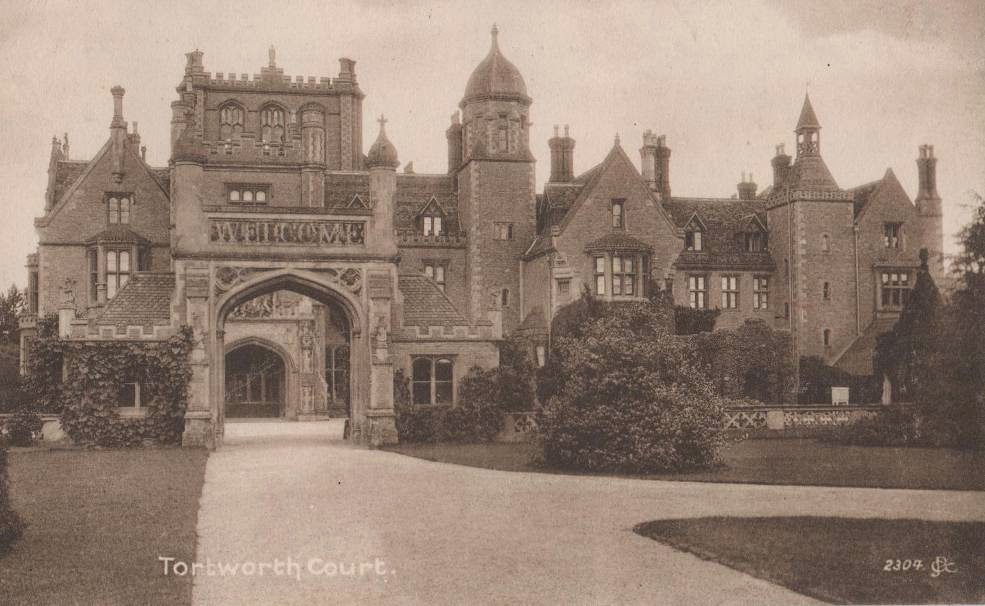
HMS Cabbala was another ‘stone frigate’ and during Dad’s time was situated at Tortworth Court, Wotton under Edge, midway between Gloucester and Bath.

Tortworth Court before the War.

Tortworth Court had been the estate of the Ducie Family since 1620. The family seat was originally at Woodchester high in the Cotswolds. As the 2nd Earl suffered from rheumatism and arthritis he decided to build a new, more commodious house, at a lower elevation and less prone to fog and wind. Samuel Sanders Teulon was chosen as the architect and the house was completed between 1849 and 1853. It was equipped with all mod cons of the age, including gas lighting with its own gas works and hot air central heating the furnaces of which were supplied with coal by its own railway. The 3rd Earl further developed the property and added a still important arboretum in the grounds. The 3rd Earl died in 1921 and as his son had predeceased him the title passed to his brother who was farming in Australia. The 4th Earl died in 1924 and his son inherited. He was also farming in Australia but divided his time between there and Tortworth Court.
At the outbreak of the War the family was in Australia. He offered the house for use by the Australian Navy but the British Navy took it over as HMS Cabbala in 1941 for use as a code and signal school. As all shore establishments are considered to be ‘ships’ by the navy the morning and evening flag ceremony had to take place but as HMS Cabbala was semi secret the flag was erected in the central hall away from prying eyes. In 1942 HMS Cabbala was relocated to Warrington and the house taken over by American servicemen. A hospital was built in the grounds and there the American wounded from the North African campaigns and the D Day landings and advance into Germany were treated.

After the War the 6th Earl died and his son took over the running of the estate. It is still in the family and is very well and efficiently run. Tortworth Court was sold for conversion into luxury flats and houses but a fire in 1991 caused everything to stop. The building was left derelict until 1999 when it was bought and sensitively restored to a luxury hotel by Four Pillars Company.

Dad was there for about three and a half months for the training as a Coder. I haven’t got much information about what was involved but obviously they received signals and had to either decode or encode them for transmission or reading.


Prior to a posting to a vessel Dad was again listed as being attached to another accountancy ‘stone frigate’.